
In Plato’s Phaedrus, Theuth offers ‘writing’ as a gift to King Thamus. In a world without writing, one had to develop their memory, for it was the only way to accumulate knowledge. Memory was the central scarce cognitive resource - what you know, who you know and what you can process was restricted to your ability to remember. And written words overcame this cognitive hurdle.
While writing would soon allow us to create the word of god, the state law, and allow for endogenous technological growth, Thamus refused this gift. He predicted that the ability to write will produce ‘forgetfulness’ in those who learn it. People will stop practicing their memory and gain only an ‘appearance of wisdom’; Thamus distinguishes between mnēmē, the living memory held inside a person, and hypomnēsis, the external reminder. The first is wisdom but not the second.

Written Word was the first technological revolution that allowed humans to offload our cognitive load. While Thamus was right about the mechanism of the cognitive offloading, he was trivially wrong about the conclusion → wisdom wouldn’t die with writing information down. I think it’s interesting to see that cognitive offloading has a general pattern - each major technology makes the previous era’s defining cognitive ability abundant and wisdom (as both, a social label and a wage premium) becomes whatever is now scarce.
The philosophical groundwork here belongs to Bernard Stiegler. In Technics and Time 1: The Fault of Epimetheus, he argues that all technology is externalised memory - each new form of technology shifts what humans need to carry in their heads and he calls this ‘proletarianization’. While Stiegler is interested in what technology takes from us, I’m interested in the empirical evidence behind it and defining a somewhat objective metric for ‘wisdom’ to dissect the impact of technology.
A Function for Wisdom
To make the ‘wisdom migrating’ idea more precise, let the brain’s many capacities (for eg, memory, interpretation, application, curation, etc) be represented as
Now the more a capacity has been externalised into tools, the more abundant it becomes (as written word spreads, the need to hold knowledge inside your head drops; technology now supplies knowledge to everyone, so its abundance increases). So for each capacity i, abundance Ai grows as externalisation Ei(t) grows:
Ei(t) is how much of capacity i has been deposited into the technology in era t. a is a baseline constant, and p > 0 controls how fast externalisation turns into abundance. The exponential means externalisation compounds and each time a capacity gets absorbed into a tool, it becomes easier to build the next one.
Simple economics says that society values something in inverse proportion to its abundance (the more you have of something, the less you value it). The weight wi tells you how much wisdom-credit a person gets for holding capacity i. The weights are normalised to sum to one (that’s why the big summation on the bottom) so when one capacity’s weight rises, another’s must fall:
The exponent y > 1 makes this winner-take-most situation; a capacity that is twice as scarce gets more than twice the reward. An individual’s wisdom is then just the weighted sum of everything they can do and each capacity is counted by how scarce it currently is. Each era crowns whichever capacity is currently scarcest:
So what happens when a new technology arrives? It externalises one capacity - say, memory into writing. That blows up A_memory, which takes w_memory toward zero. But the weights must sum to one, so that weight doesn’t disappear and it migrates to whatever capacities the technology didn’t touch. While the mathematics aren’t crucial to grasp, it’s important to note that:
Capacities are never destroyed. Your memory still works after the written word comes into existence but with w_memory as approximately 0, it stops being called wisdom.
Rewards are winner-take-most. Because y > 1, society puts status / money on whoever holds the single scarcest capacity. That’s why each era has a recognisable class of the wise (priests, scholars, engineers) rather than a smooth gradient of people being somewhat wise for different things. Hopefully, this pattern should show up in wages and market premium for a capacity would track its weight:
When a technology makes a capacity abundant, its wage premium should collapse. When a new scarcity forms, a new premium should appear. The rest of the essay walks through 3 eras and checks those predictions against data.
Era 1: Print
For two thousand years after writing, texts were so scarce that even ownership gave status. But print ended that. Buringh and van Zanden estimate that Western Europe produced more books in the fifty years after Gutenberg than in the previous thousand years and the curve never bent back:
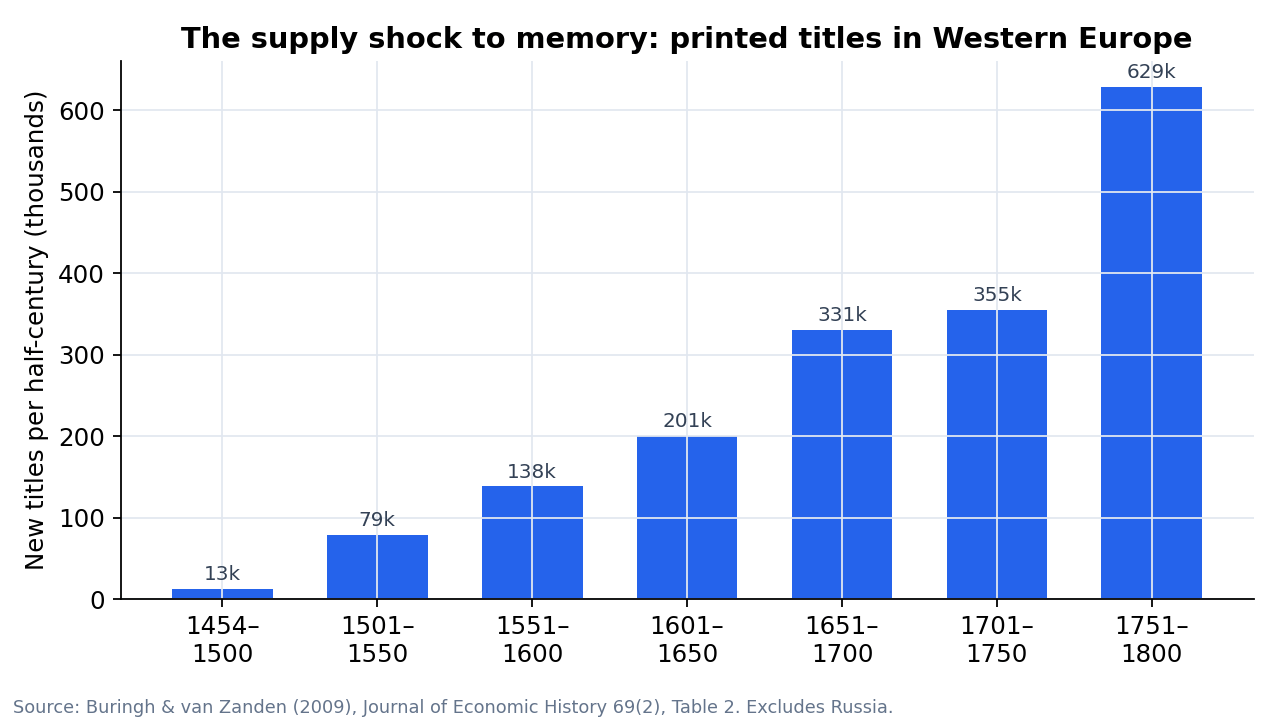
From about 13,000 new titles in 1454 to about 629,000 in 1800, with total copies crossing a billion in the eighteenth century - having memorized a text became worthless as a marker of wisdom. The scarce thing became what you could do with it: reading closely, arguing about what texts meant, and building systems of thought from them.. The wise man of this era is the scholar. As Elizabeth Eisenstein writes, the press made the Church’s monopoly on reading the Bible visible as a monopoly for the first time. Before print, most people never saw scripture, the priest interpreted it for them. Once anyone could have the text, the question of who got to say what it meant became a live fight. Those who were able to interpret texts in the most convincing manner won this era.
Era 2: The Industrial Revolution
The Industrial Revolution, in this context, is a story about what the machine replaced: the craftsman’s skill. Before industrialisation, making something well required years of apprenticeship to build a feel for the material; that knowledge lived in the hands of workers and couldn’t be written down. But the machine replaced that. A textile mill didn’t need a master weaver who understood thread tension through feel. The clearest sign of this re-sorting is how quickly the labour force changed. In 1800, three-quarters of the US labour force did one thing: farm. By 1960, it was 8%, and the workforce had split into a hierarchy of operatives, machinists, clerks, engineers.
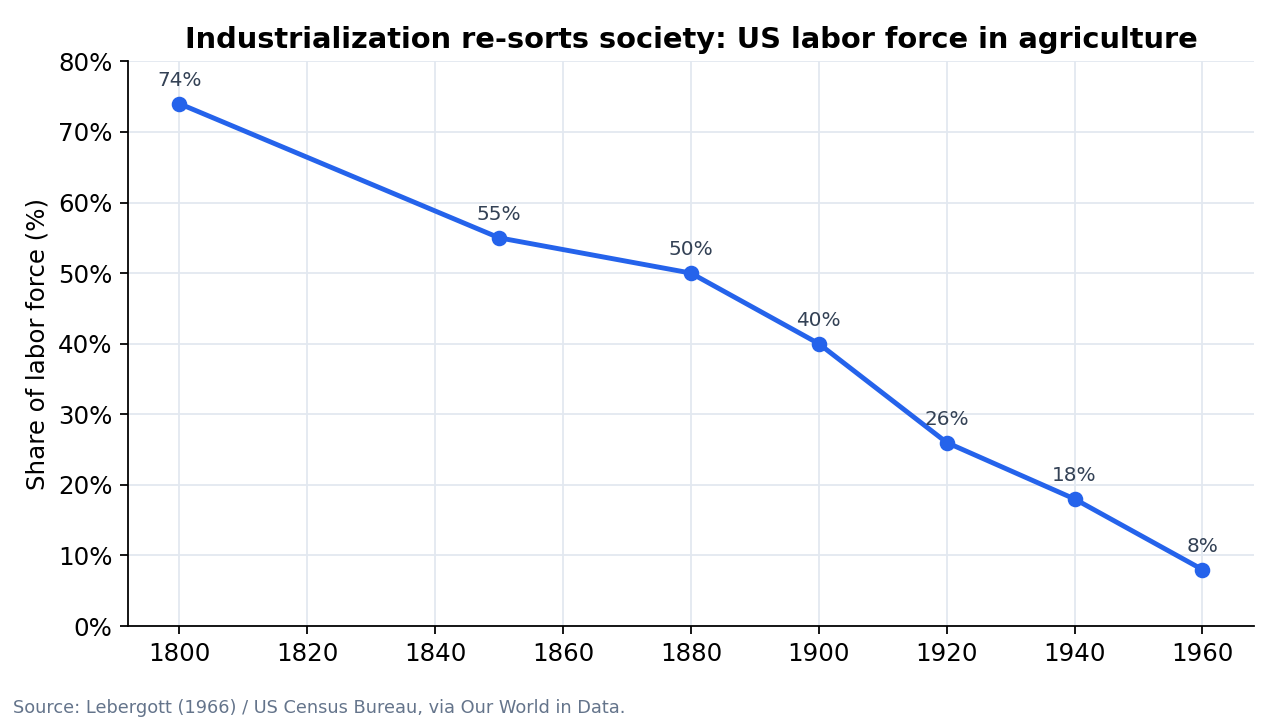
Two things happened inside this re-sorting, and our function predicts both:
The old premium collapsed. Katz and Margo document how industrialisation ‘hollowed out’ the artisan class across the nineteenth century. The share of middle-skill craft jobs (blacksmiths, weavers, shoemakers) shrank as factories replaced their work with machines.
And a new premium was born. The machine made craft abundant but created a new scarcity. The scarcity was what Polanyi called tacit knowledge: one who could ‘know more than they could tell.’ One could print a thermodynamics textbook but one could not print the judgment of the person who knew why a boiler vibrated 5 min ago. So w_application became the scarce resource, and the era’s winners became people like Edison, Brunel and Bessemer.
The twentieth century then spent itself externalising knowledge application. The cleanest trace of that era’s endgame is the college wage premium - the extra percentage a degree holder earned over a high school graduate each year (FRED LEU0252918500A).
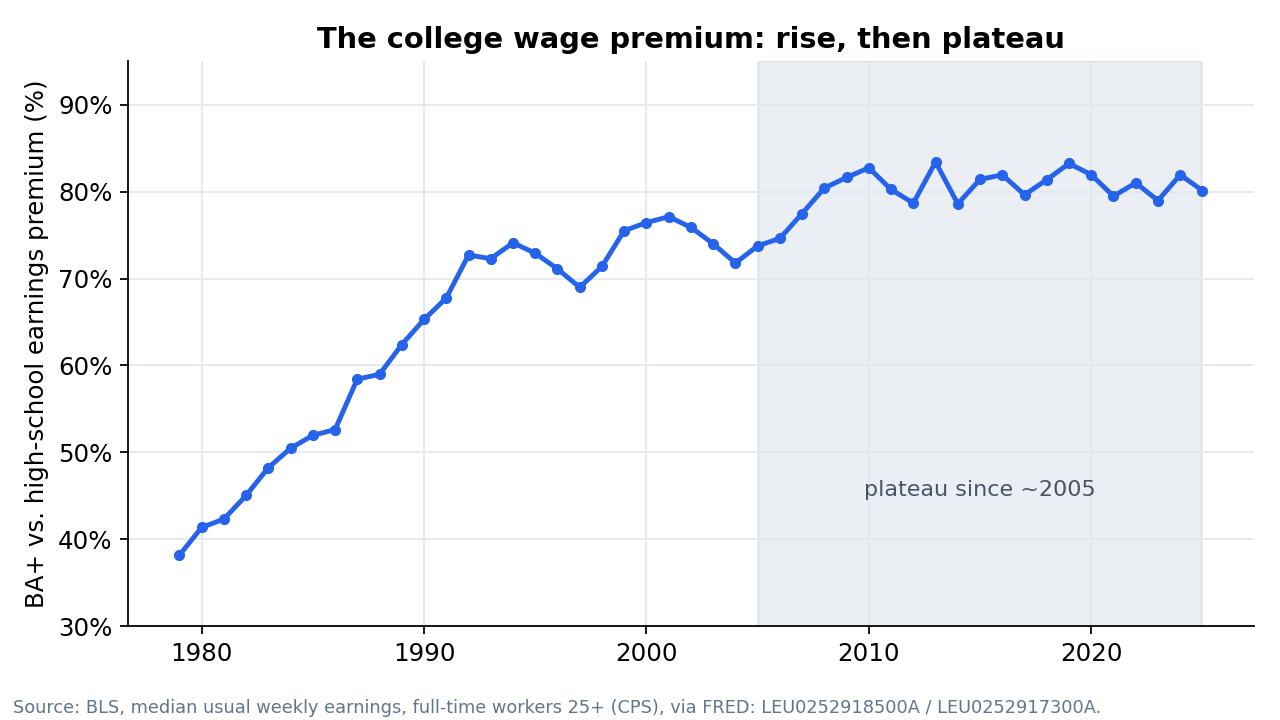
The premium more than doubles, from 38% in 1979 to about 80% by the late 2000s but then it stops. It has oscillated around 80% for two decades, and the NBER says the flattening happened around 2005–2010. I don’t think the timing is not a coincidence - it was the start of the next revolution that made the application of information an abundant resource again.
Era 3: The Internet
The internet made applied knowledge abundant. The internet externalised applied expertise as questions like ‘‘how do I do X’ became a single query rather than a career. But the same technology made information itself explode. In 1993 there was one website. By 2000 there were 17 million but by 2017 there were 1.7 billion.
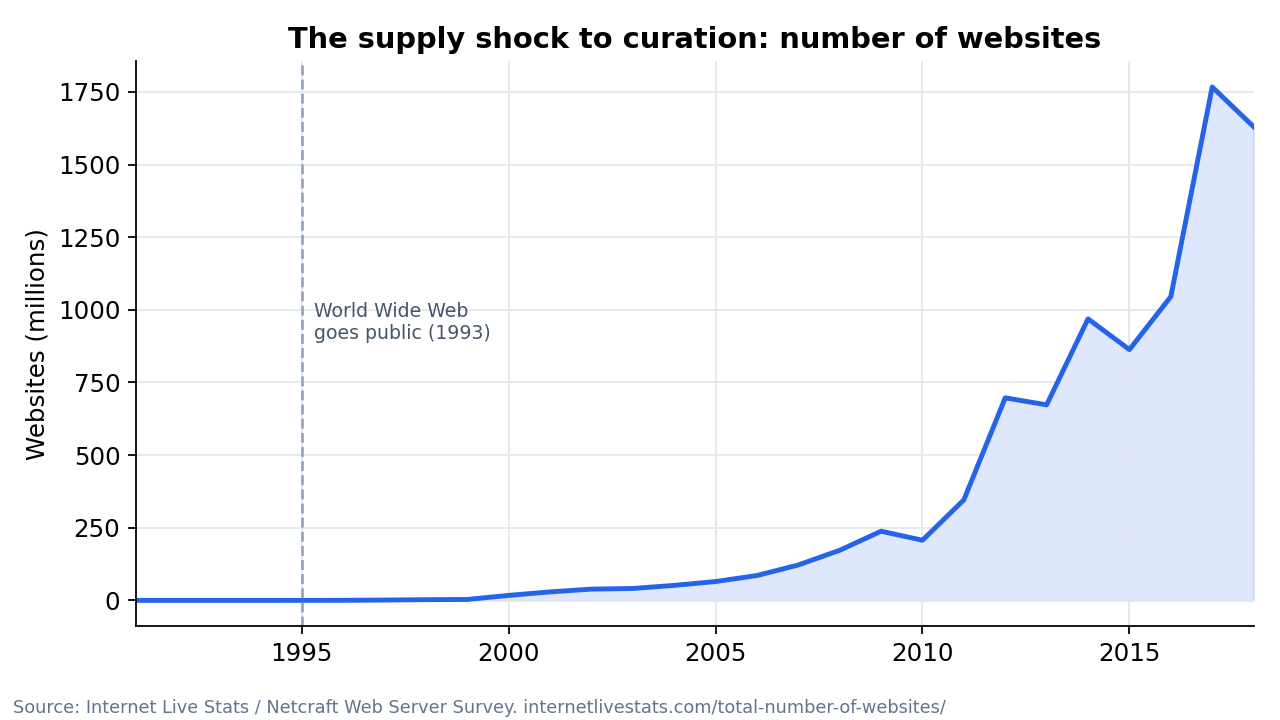
In our model: A_info → ∞, so the value goes from application to filtering. The scarce capacity (the new wisdom) became curation - knowing what, out of everything, deserves attention. And the economic record of the internet era is largely a record of curation winning.
Yahoo vs. Google is a key example. Yahoo began as a hand-curated directory and Google’s insight was to replace human judgment with an algorithm (PageRank) that could scale to the entire web. When Paul Graham told David Filo they should buy Google, Filo replied that search was only 6% of their traffic and not worth focusing on. The company that thought curation was a side feature lost. Now, Netflix says 80% of streaming comes from recommendations and so does 70% of Youtube streaming.
This emphasis on being able to curate directly shows up in wages too. Throughout the internet era, software developers (the clearest proxy for the kind of filtering work the internet made valuable) earned roughly double the mean wage of all workers (BLS):
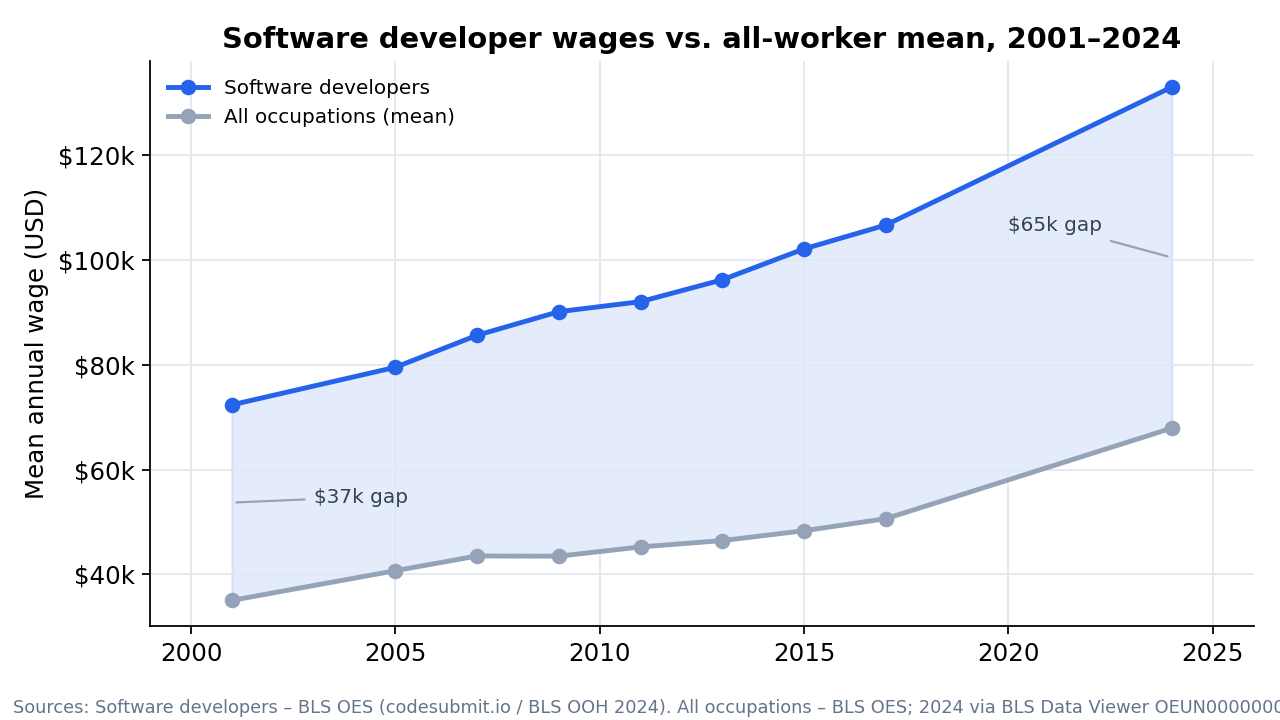
The people this era that were wise were not the ones who knew things (knowing was free) but the editors-of-knowledge - the investors, the tastemakers, and content creators that were worth following.
Era 4: AI
Now the pattern runs again. LLM’s externalise the two capacities the internet left scarce: curation (the model can read everything and returns the five things that matter to you is a filter) and synthesis (combining sources into a coherent argument is now a commodity service). If our function holds, the premium on curation / synthesis as jobs should collapse like how the college premiums did after 2005 - when the internet made applied knowledge abundant enough.
But it’s also important to note that no previous shock has moved this fast. Stanford’s AI Index 2025 reports that querying a GPT 3.5 level model fell from $20 per million tokens in November 2022 to $0.07 by October 2024, a 280x decrease in eighteen months. The constant ρ in the abundance formula represents how fast externalising a capacity turns into abundance. Print’s ρ was tiny (texts took fifty years to get ten times cheaper) and the scholar’s premium lasted centuries. The engineer’s lasted about 150 years and the curator’s, a few decades. The scarce-skill window keeps shrinking, and that shrinkage is ρ rising. It’s possible that AI’s ρ is so big that the premium can appear & collapse before the people chasing it have finished chasing the new wisdom.
But where does wisdom go this time?
Till now I’ve treated capacities as if a technology could externalise one and leave the rest alone. But capacities aren’t independent. Being good at one usually means being good at related ones, and technology, in particular AI, inherits that link. AI made writing code cheap, which made reflection through prototyping cheap, which made ideation through product experimentation cheap. Nobody built three separate tools but one capacity was externalised and pulled the related ones with it.
So externalisation spreads along correlations. If AI targets some capacity k, the abundance does not stay in one place; it spreads to every capacity i in proportion to how related the two are:
where σ_ik is how closely capacity i moves with k. Any capacity close to what AI replaces will lose value - a whole cluster becomes abundant together, not one capacity at a time. This is where Stiegler’s idea starts to break. Proletarianization assumes a skill leaves the worker and enters the machine. The worker retains what remains but this only holds when a technology takes one capacity at a time. AI is taking whole clusters at once and as we approach AGI, it externalises more of the capacity vector simultaneously.
So what remains? I think wisdom, in AI’s case, doesn’t migrate to whatever is scarcest but to what is orthogonal - capacities that can’t be bundled with what the machine makes abundant. Progress is augmenting skills faster than we can identify the next scarce thing. The better question isn’t what becomes scarce next, but what is so disconnected from traditional cognition that automation can never produce a bounce-off effect on it. I can think of two such capacities.
Questions. Every AI tool is an answer machine. None of them want to know anything. The hard part is not answering questions but noticing which ones are worth asking. Frankfurt drew a line between a person and what he called a wanton: a person cares about what moves them, while a wanton just acts on whatever impulse is strongest. A machine does not eat, die, or need anything, so it is the clearest example of a wanton. You cannot outsource the wanting.
Responsibility. Owning the output, putting your name on it, and bearing the cost when it is wrong is not a cognitive task. That is why it cannot be offloaded like recall or synthesis. It is unrelated to the whole cluster by definition: nothing the model does touches it. Until we let fully autonomous agents make every decision with no human intervention, someone has to be accountable, and that someone cannot be the machine because it doesn’t have moral status (yet).
In Plato’s story, Thamus wasn’t wrong. But every time a new tool arrives, humans accept it, the old skill gets cheaper, and wisdom moves to whatever the tool cannot do. So the question that matters is not what the new machine can do, but what it leaves scarce (or in this case, what is orthogonal to traditional capacities). That is what the next era will call wisdom.