
On Thinking
“A key part of our mission is to put very capable AI tools in the hands of people for free (or at a great price).”
Sam Altman, “GPT-4o” (2024)
“Thinking is solved!” a friend of mine blurted out after a swarm of AI agents took off building at the Oxford ETH hackathon, late 2025. The Republic1, a peer-reviewing intelligence platform with an AI engine, could be built in just a few days with Opus 4.6. Fact-checking papers with AI could be completed in a few hours. The project itself stood as a hypothesis of how AI could deliberate intellectually, process arguments, and self-reflect on the claims of research papers.
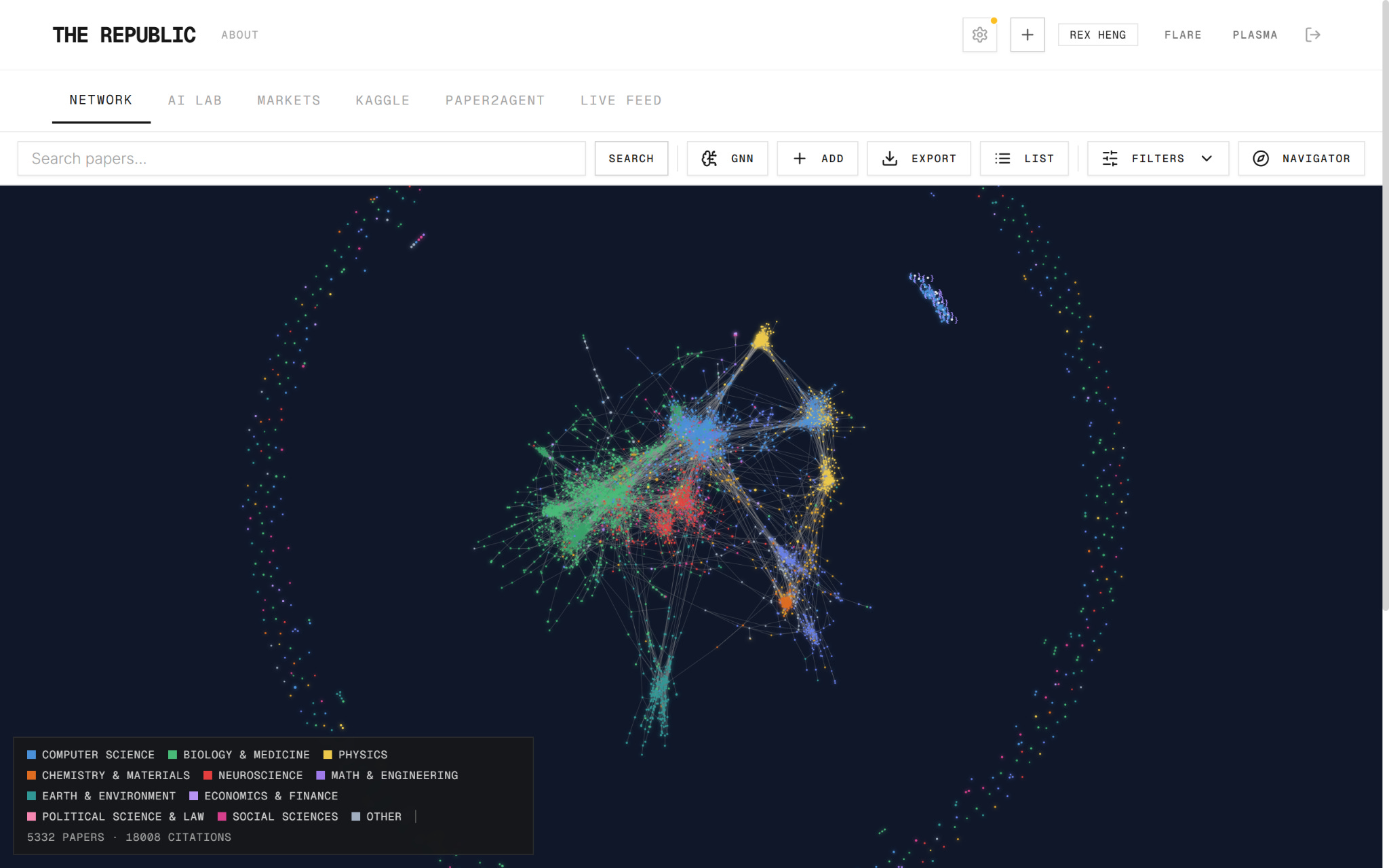
What started off as a hackathon project has, as of 2026, been validated by systems like the AI Scientist2 and Google DeepMind’s Co-scientist3. Beyond autonomous research, AI is often used as a high-level thinking assistant: Terence Tao suggests it may advance experimental mathematics4, models have captured headlines solving Erdős problems, and it has become a routine tool in protein structure prediction. There is no shortage of discussion on the superb capabilities of these tools. LLMs now simulate complex thinking, including research, brainstorming, and synthesis. Frontier models can handle long-form tasks, complex problem-solving, and areas involving some human judgement. But better models also fetch higher prices5, with Claude Fable priced at $50/Mtok per output, ten times the rate of a weaker model like Haiku 4.5.
I want to look at this trend in a way distinct from the dominant framings of AI: labour economics6, techno-feudalism7, and surveillance capitalism8, though all of these find their way tangentially into my analysis. The core philosophical shift, to me, is that artificial intelligence has commodified thinking. Human cognition has become partially substitutable, and its cost can be abstracted to the price of tokens. A domain historically untouched now has a direct price signal.
History of AI Thinking
Earlier computing precluded abstract cognitive work. IBM’s Deep Blue and DeepMind’s AlphaGo are examples of narrow AI, confined to a single domain with no general capacity to think. OpenAI made its name with OpenAI Five, which beat the Dota 2 world champions in 20199 using a generalised reinforcement learning method.
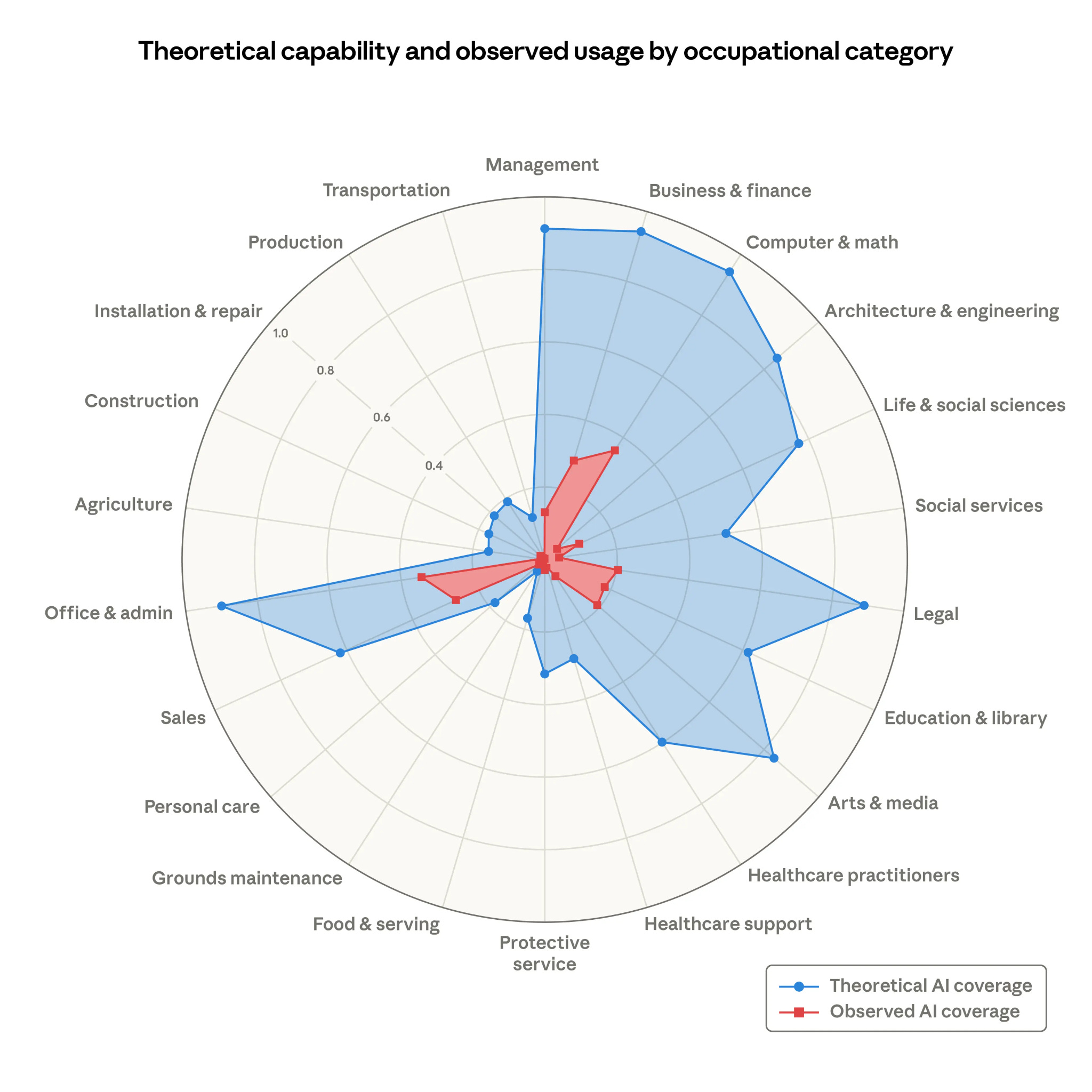
The landscape today is vastly different. People regularly consult AI on a variety of tasks, and these applications suggest the general competence of LLMs: a form of baby general intelligence capable of work across multiple domains. A broad range of tasks are becoming convincingly replicable by AI, driven in part by scaling but also by developments in the thinking architecture. Anthropic’s economic research shows how AI’s coverage across industries will only increase as models get more capable10.
Recent developments also point to processes that resemble deliberation. Chain-of-thought prompting11 and ReAct (reasoning and acting)12, push models to externalise intermediate steps that resemble the form of human reasoning. Pioneered by the Q* model which evolved into o1 from OpenAI, models began to adopt advanced reasoning, self-correction, and stepwise planning. It is now almost ubiquitous for models to include an internal ‘thinking’ process instead of a lookup mechanism: Claude’s Extended Thinking, Google’s Deep Research, DeepSeek and Kimi’s thinking modes solve problems through intermediate reasoning.
Thinking is a unique kind of good in this regard. Shunyu Yao characterises it as not influencing the external world directly14, but determining the quality of output. Not all AI output is usable. A Stanford paper quantifies this through the ‘cost of pass’, where one measures the total ‘goodput’. The expected monetary cost of generating a correct response, influenced by the cost of inference and the probability that the answer is accurate15.
Once thinking carries a price per correct answer, the choice between thinking for oneself and buying it tends toward a standard consumption decision.
Standard Consumer Theory
Having a price tag for thinking invites analysis with economics. If an accurate judgement can be bought by tokens, thinking for oneself becomes a decision about relative cost. We can treat “manual thinking” and “AI thinking” as two substitutable goods, and a rational thinker chooses between them until the marginal benefit per unit cost is equal across both. Represented on an indifference curve, this optimum sits where the marginal rate of substitution between the two equals their ‘price’ ratio.
As models get better, the relative price of AI thinking falls below manual thinking. The budget line pivots, and the substitution effect pulls demand toward AI thinking. In other words, the share of one’s intellectual thinking declines. People switch from thinking by themselves to having the model work it through for them.
Never in history have we had such a close substitute to human thinking. The closest example in the pre-GPT era of outsourcing thinking would be some form of cognitive arbitrage. A famous example would be in Verizon, where a developer named Bob, paid a Chinese consultancy to do all his coding tasks and work, rising up to become the firm’s best programmer. Outsourcing one’s own labour resembles offshoring thinking to some extent. But what we can do with AI today reaches much further and at an extremely granular level. Market and token economics can entrench themselves in the process of human thinking across several domains.
Thinking at a price.
“Are there some things that money can’t buy? My answer: sadly, fewer and fewer.”
Michael Sandel
The calculus for solving many of the complex problems we now face is: can AI do it? If so, how many tokens will it cost? Stepping back from the purely economic model, pricing AI thinking adds a new alternative to how humans think and approach problems.
Kahneman famously categorised two main modes of thinking, System 1 and System 217. But there might be a third: outsourced thinking at the price of tokens. Shaw and Nave propose a ‘System 3’, with thinking that occurs outside the human brain. We defer our thoughts to AI in a price approximated by tokens. Intuitive and deliberative thinking are thus removed from the equation altogether. Now, I would not frame this in the common doomer stance that AI causing the atrophy of our mental faculties. If anything, I believe it has widened and deepened access to information and learning. The problem I identify is instead, one focused on the ethical and philosophical implications of commodifying thinking.
First, AI alienates thinking from the thinker. Humans are creative beings, and desire a connection to their work. In a typical Marxist account, a worker is alienated from the products of his labour, and that estrangement creates distress. Whether you agree with Marx or not, the direct connection to one’s work is what gives a lot of us meaning. For if one were to labour without seeing the end-product or feeling the connection to the whole process, one tends to grow restless. Some argue that AI tools embolden creativity, allowing individuals to create without all the technical knowhow. For instance, tools like Lovable enable anyone to design captivating front-ends.
To me, its easy to sarcastically criticise the boilerplate purplish front-ends and glassmorphism as pseudocreativity, but the bigger question is: where do we draw the line of ownership between the creator-thinker and the product? On closer inspection, we don’t own the models that create our work. We don’t own the process of creation, and own only the prompt. Closed-weight models blackbox the process of creation, preventing us from understanding how the models come to their decisions. We plug the task into Claude and twiddle our thumbs until the output pleases us, and iteratively ask the LLM to “make it look nice”. Marx saw alienation in the labourer who did not own his product. What then, do we make of the thinker who no longer owns his thinking?
Second, the ownership of inference capital permits the extraction of rent on thinking itself. Dario Amodei addresses this in Machines of Loving Grace, warning of a polarisation that could widen the gap between the AI-native and the non-native19.
“[T]he people who are least able to make good decisions opt out of the very technologies that improve their decision-making abilities, leading to an ever-increasing gap and even creating a dystopian underclass” - Machines of Loving Grace, Dario Amodei
The reality is that AI underserves large groups of people, the global south and women among them20, and concentrates decision-making power in a handful of silicon valley techno-elites. Once we attribute a price tag to something like thinking, the disenfranchised, and those who lack power are left out of the calculus. It is unlikely that AI will produce trickle-down effects or grand distributive social impacts, of which Karen Hao criticises in her book Empire of AI. Token costs are indeed falling for the same tasks, but fundamentally AI still remains unequally distributed. It is hard to see how commodifying thinking will equitably benefit everyone.
Conclusion
Thinking and its commodification is not something we can outright reject. Luddite movements and anti-technology tend to dissolve over time, and often the task at hand evolves into finding ways to adapt new technologies in an equitable way. Outstanding AI capabilities emerge every other week, and the rapid pace of development contributes to the narrative that eventually, AI might be able to replace everything — bringing AI thinking as an even closer substitute to human judgement. Is thinking solved? The answer is no for now, but it approaches a comparable competency across multiple domains. One denominated in API costs, the level of subscription, and tokens.
References
1. The Republic. (2025). The Republic [AI peer-review platform]. https://the-republic-ashy.vercel.app/
2. Lu, C., et al. (2024). The AI Scientist: Towards fully automated open-ended scientific discovery. arXiv. https://arxiv.org/abs/2408.06292
3. Google DeepMind. (2026). Accelerating scientific discovery with Co-Scientist. Nature. https://www.nature.com/articles/s41586-026-10644-y
4. Patel, D. [@dwarkesh_sp]. (2025). [Post on Terence Tao and the Erdős problems]. X. https://x.com/dwarkesh_sp/status/2036095632746983436
5. Anthropic. (2026). Claude API Docs. https://platform.claude.com/docs/en/about-claude/pricing
6. Autor, D. H. (2015). Why are there still so many jobs? The history and future of workplace automation. Journal of Economic Perspectives, 29(3), 3–30; Acemoglu, D. (2024). The simple macroeconomics of AI (NBER Working Paper No. 32487). National Bureau of Economic Research.
7. Varoufakis, Y. (2023). Technofeudalism: What killed capitalism. The Bodley Head.
8. Zuboff, S. (2019). The age of surveillance capitalism: The fight for a human future at the new frontier of power. PublicAffairs.
9. OpenAI. (2019). OpenAI Five. https://openai.com/index/openai-five/
10. Anthropic. (2025). Labor market impacts [Research]. https://www.anthropic.com/research/labor-market-impacts
11. Wei, J., Wang, X., Schuurmans, D., Bosma, M., Ichter, B., Xia, F., Chi, E., Le, Q., & Zhou, D. (2022). Chain-of-thought prompting elicits reasoning in large language models. arXiv. https://arxiv.org/abs/2201.11903
12. Yao, S., Zhao, J., Yu, D., Du, N., Shafran, I., Narasimhan, K., & Cao, Y. (2022). ReAct: Synergizing reasoning and acting in language models. arXiv. https://arxiv.org/abs/2210.03629
13. Yao, S. (2025). The second half. https://ysymyth.github.io/The-Second-Half/
14. Erol, M. H., El, B., Suzgun, M., Yüksekgönül, M., & Zou, J. (2025). Cost-of-pass: An economic framework for evaluating language models. arXiv. https://arxiv.org/abs/2504.13359
15. CNN Business. (2013, January 17). U.S. programmer outsources own job to China, surfs cat videos. https://www.cnn.com/2013/01/17/business/us-outsource-job-china
16. Kahneman, D. (2011). Thinking, fast and slow. Farrar, Straus and Giroux.
17. Shaw, S. D., & Nave, G. (2026). Thinking—Fast, slow, and artificial: How AI is reshaping human reasoning and the rise of cognitive surrender. PsyArXiv. https://doi.org/10.31234/osf.io/yk25n_v1
18. Amodei, D. (2024). Machines of loving grace: How AI could transform the world for the better. https://darioamodei.com/essay/machines-of-loving-grace
19. Hao, K. (2025). Empire of AI: Dreams and nightmares in Sam Altman’s OpenAI. Penguin Press.